
The principles of Visual Management are related to each other, with the over-arching goal of the following: 目视化管理的原则互相关联,其综合目标包括以下三个方面: 1.Visual Management Makes Problems Visible 目视化管理让问题可视化; 2.Visual Management helps to immediately distinguish “normal” versus “abnormal” conditions 目视化管理可以让我们可以快速识别“正常”与“异常”情况; 3.Visual Management helps us to respond immediately 目视化管理可以让我们能够快速响应 But, for us to know “normal versus “abnormal” conditions, there must be a standard. 对于我们来讲,理解“正常”与“异常”情况,必须有标准存在! A Basis for Comparison 对比的基础 A standard can be described the picture below: 标准可以用下图来描述: The image above shows a hill, a wedge, and a ball. Each element represents the following concepts: 以上图片中的斜坡、楔形与圆形,分别代表的含义是: 1.Hill represents Improvement 斜坡,代表改善 2.Wedge represents Standard Work 楔形,代表标准化作业 3.Ball represents the thing we’re trying to improve – product, process, service – whatever 圆形,代表我们正尝试进行改善的产品、工艺,任意一种服务 Once we improved the process, service,or product with Plan-Do-Check-Act (PDCA), then the newly-improved process is standardized via the wedge, or standard work. 一旦我们利用戴明环来改善工艺,服务,或者产品,新的流程就可以通过楔形表示的标准化进行改善。 Then, we continually improve via PDCA. And whenever we do, we standardize the new process. 随之而来,我们通过戴明环不断改善,无论何时,我们都会对新的流程进行标准化。 A Standard allows us to have a basis for comparison and allows us to see what is “normal” versus “abnormal” conditions. Without a standard, we don’t know and cannot tell what condition our process, service, or product is in. 标准,让我们拥有对比的基础,能让我们发现什么是“正常”状态,什么是“异常”状态。而如果没有标准,我们就不知道,同时也说不出流程、服务与产品的状况究竟是怎么样的。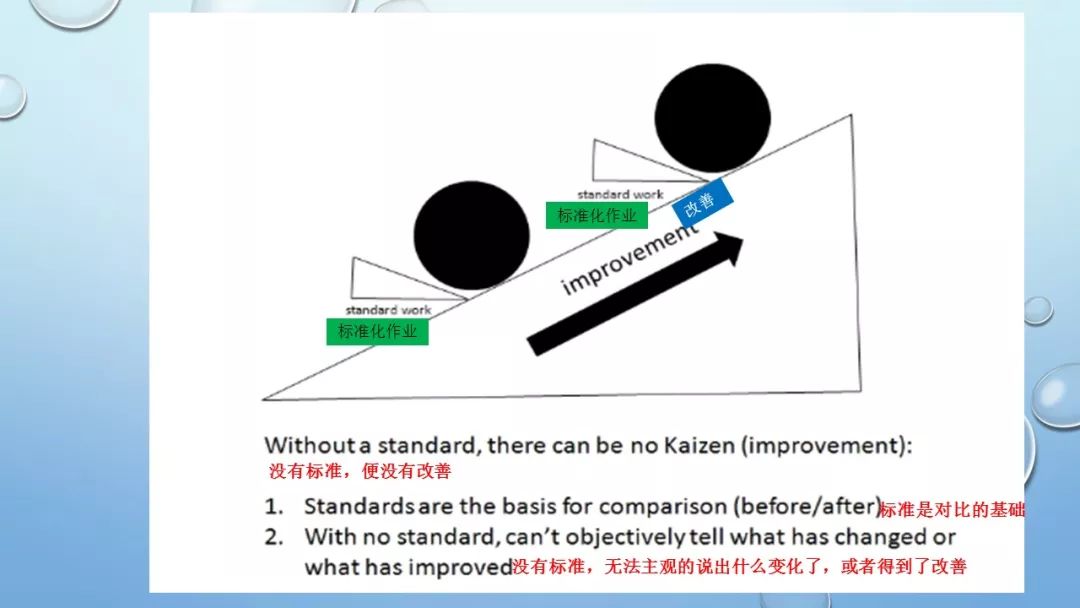
 扫码关注公众号
 项目联系人
项目联系人